Marianne Salimkhan on Hermès, Craft, and the Quiet Disappearance of Luxury
By the time Marianne Salimkhan speaks about Hermès, you understand this is not brand loyalty — it is lived knowledge.
Salimkhan has handled hundreds of Kelly bags, owned more than she can easily count, and worked inside the very ateliers that once defined French haute couture. Her expertise is not theoretical. It is tactile. The collector knows luxury by feel — the weight of box leather, the tension of a handle, the silence of a room where thirty seamstresses worked without speaking.
“I don’t believe luxury can be explained,” Salimkhan says. “You either feel it, or you don’t.”
Born and raised in Nice, Salimkhan carries what she calls a “southern soul” — a sensitivity to light, colour, and energy that never quite softened after moving to Switzerland. Her background in couture began early, as a student at the École de la Chambre Syndicale de la Couture Parisienne, an institution designed to train future artisans for the great maisons.
“We were living the very end of a traditional era,” the collector reflects. “The method hasn’t changed — the mannequins, the toiles, the bolducs — but the world around it has.”
After graduating, Salimkhan worked at Givenchy under Hubert de Givenchy himself, an environment she remembers as both sacred and severe. “It felt like being on a mission,” she says. “Excellence was expected at every minute. Silence had weight.”
Later came Chanel, where she hand-stitched skirts for the maison’s iconic tailleurs. “Every stitch was done by hand. No flaw was tolerated. If you wasted fabric, you paid for it.”
That world, Salimkhan believes, no longer exists in the same way.
“The shift happened in the early 2000s,” she says plainly. “Luxury stopped being about the product and became about the brand.”
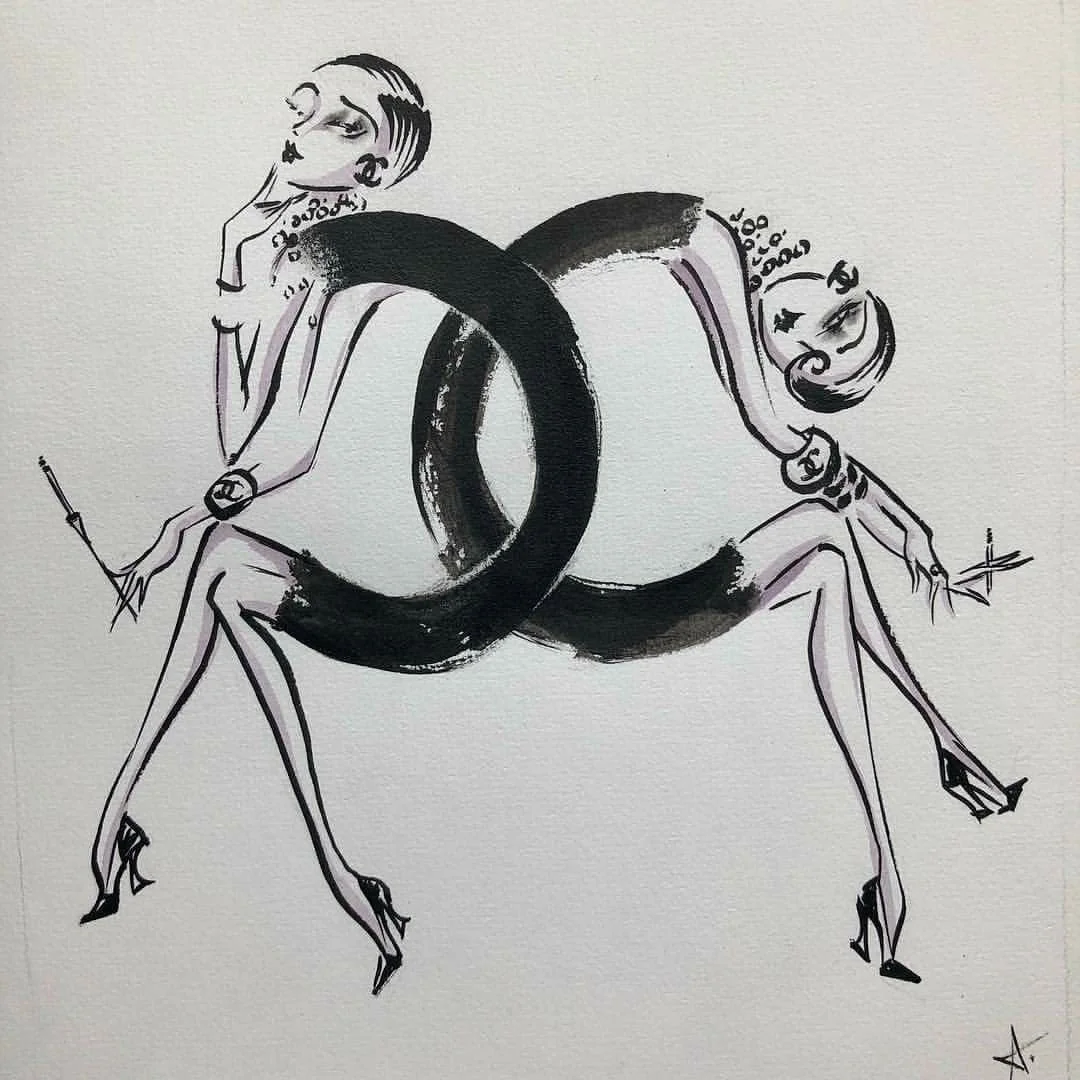
At Chanel, the collector observed the transformation firsthand: centralised retail, scripted language, uniform sales experiences. “They stopped saying ‘price’ and started saying ‘value.’ They repeat names — Mademoiselle Chanel, Monsieur Lagerfeld — as if invocation alone creates meaning. It’s branding theatre.”
She is particularly critical of what she calls “the layers.” “Packaging, ribbons, camellias, cards — people call it experience. I call it waste. None of it improves the product.”
As for the bags? “They are recognisable. They are fashionable. But they are not worth what they retail for,” Salimkhan says. “Chanel entered the industrial era. Period.”
Hermès, however, is a more personal subject.
“What I loved about Hermès,” Salimkhan says, “was that it adapted to your life — not the other way around.”
She speaks fondly of stores that reflect their surroundings: the mountain warmth of Gstaad, the fisherman’s house in Saint-Tropez, the thick walls of Saint-Moritz. “Hermès felt transversal,” the collector explains. “It fit every lifestyle without losing itself.”
Equally important was the human element. “Sales associates knew you — not your spending history, you. They talked to you. They advised you. They would take an order and hold your bag for months if needed.”
That intimacy, Salimkhan says, is gone. “Now, everywhere in Europe — with very few exceptions — it’s over.”
The expansion of production troubles her deeply. “Hermès now has around forty production sites in France. They even have a factory dedicated solely to Kelly bags. As a collector, that is heartbreaking.”
She notices the changes in the details. “The feel of Togo leather. The stitching on the handles. Automation has replaced hands — and it shows.”
Still, Salimkhan refuses nostalgia for its own sake. “I don’t reject modern Hermès,” she says. “You can love a vintage box Kelly for its soul and still want a new Birkin for a fresh colour. Both can coexist.”
If there is one consistent belief Salimkhan holds, it is that true luxury is rare.
“Luxury cannot be mass-produced,” she says. “Rarity is its essence.”
When asked if she will be a Hermès customer for life, Salimkhan smiles. “My first purchase was in 1987,” she says. “I’ve lived longer with Hermès than without it.”
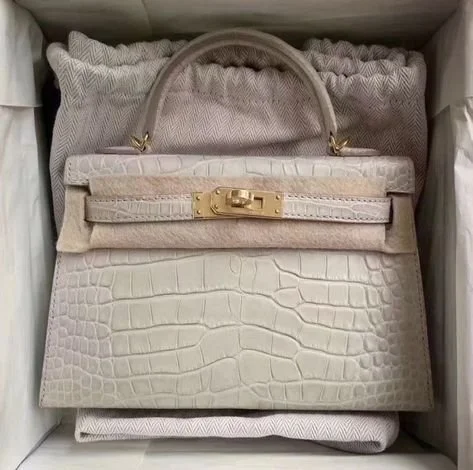
But it was not her first Kelly that marked her most profound attachment. That came later — after the birth of her daughter. To celebrate what she calls “the greatest achievement of my life,” Salimkhan bought herself an ostrich Kelly. The collector speaks of it differently from the others. Not in terms of rarity or resale value, but memory. The texture of the ostrich leather, the softness of its structure, the quiet strength of its silhouette — it became symbolic of that chapter. “I didn’t receive it as a gift,” she says. “I bought it for myself.” For Salimkhan, that distinction matters. The bag is not simply an object of craftsmanship; it is a marker of transformation, of womanhood, of independence. Among hundreds, that Kelly carries a pulse.
What the collector mourns today is something less tangible. “We’ve lost the unspoken sweetness of luxury,” she says quietly. “The discretion. The understatement. The feeling that you were entering a world, not a system.”
That is why she advises collectors to look backward as much as forward. Her list is precise: Chanel jackets from the 80s and 90s. Gripoix jewellery. Early-90s Hermès Kelly bags — “the best era for craftsmanship and materials.” These pieces, she insists, have already passed the ultimate test. “They survived. They will continue to survive.”
As for new items? “Very few will last a lifetime,” the collector says. “Perhaps a truly exceptional crocodile Hermès bag. That’s it.”
When Salimkhan handles a Kelly bag — vintage or modern — she looks for something few people consider. “You can feel the personality of the craftsman,” she explains. “When that touches your heart, you’ve reached true luxury.”
Her own wardrobe reflects her philosophy: minimal, functional, impeccably cut. “Clothing should allow you to forget about how you look,” Salimkhan says. “You should be able to live in it.”
Her advice is deceptively simple: know your body, stay in your comfort zone, dress for your real life, invest in tailoring. “Even a Zara dress can look like couture if it fits perfectly.”
And above all, she believes in signatures. “A wardrobe should have continuity,” the collector says. “Luxury is not about accumulation. It’s about coherence.”
She pauses, then adds: “I don’t chase the myth. I chase the feeling.”